

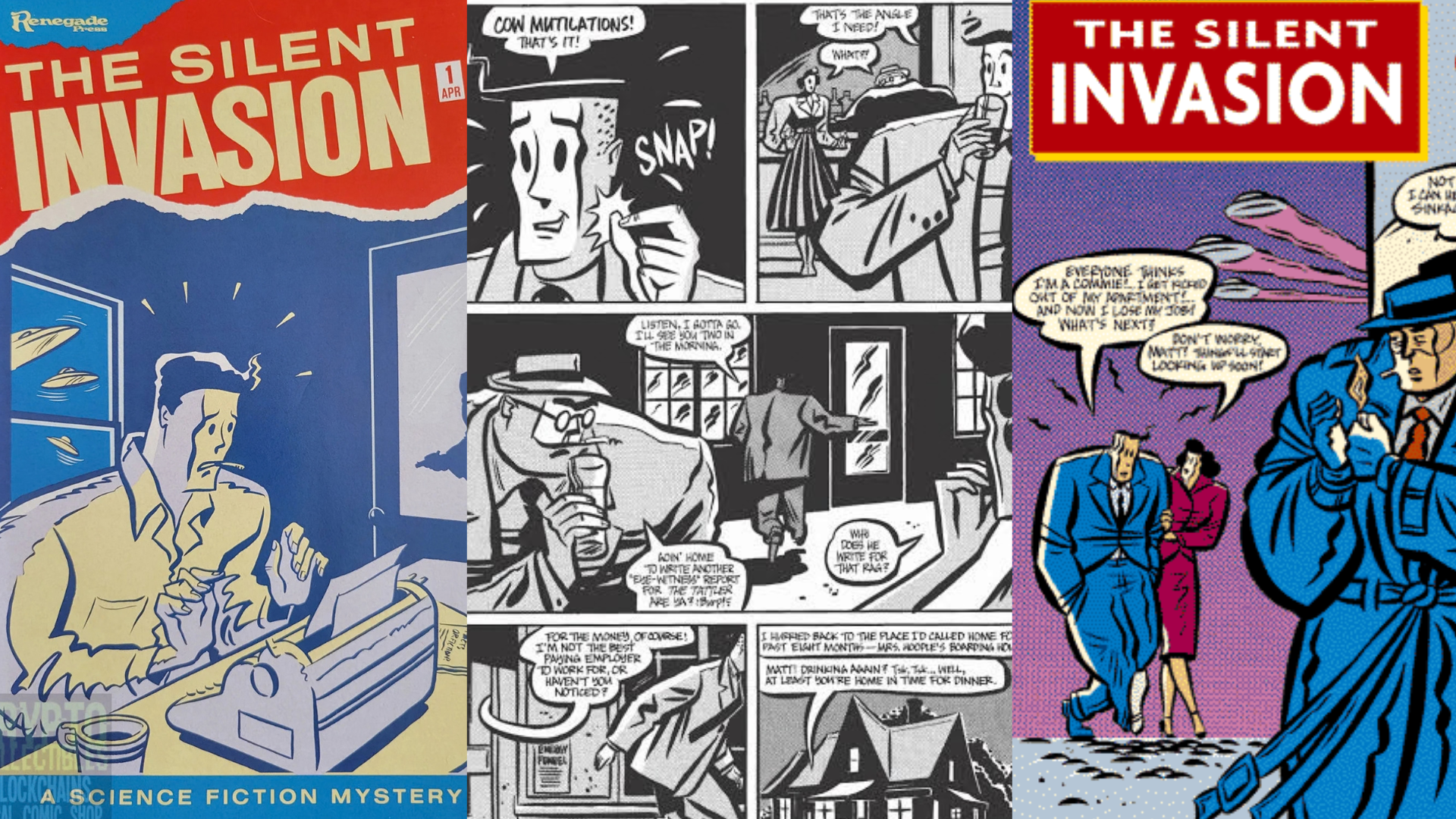
It was in a quaint used comic book store in the still summer heat of late-1960s Oshawa, Ont., where Larry Hancock and Michael Cherkas first crossed paths as fated teenage comic collectors, with their encounters more often than not nearly ending in a brawl over the final edition of whatever new comic was hot off the publishing press.
"Michael and I were both avid comic book collectors, and we met at the used comic book store in Oshawa," Hancock said. "Michael lived in Oshawa, I lived in Whitby, and we both went there, and we both were always fighting over buying the same issue of a comic book."
That childhood rivalry has since grown into a 40-year creative partnership, one that has carried Hancock and Cherkas from teenage scuffles in a comic shop to co-creating the award-nominated series The Silent Invasion, and into a lifelong friendship forged over a shared taste in comic books, with a little help from a Canadian pastime that can bring together just about anyone.
"Our friendship grew because Michael had a tabletop hockey set, and so he would invite me back to his place, and we'd play tabletop hockey," Hancock said. "It's a great Canadian thing to do as kids, and our friendship lasted from then, which was late high school, all the way through me going to university, him going to art college, and then afterwards when we have both been in Toronto working full-time jobs."
When publisher Renegade Press first reached out to the pair asking them to put together an official collaborative series, Hancock and Cherkas jumped at the opportunity and began pulling at the inspirational threads of the television series they grew up watching together.
"We both love old black and white TV shows, The Outer Limits, The Twilight Zone, and the B-movies from the '50s and such, so we decided that would be our inspiration for our very first series," Hancock told The Dispatch.
Cherkas attributes his signature illustration style to influences across continents and decades. Among the most prominent is Harvey Kurtzman, the creator of Mad, whose earlier war comics for EC in the early 1950s stuck with Cherkas for their realism. Other influences took longer to appreciate with age, among them Jack Kirby and Tintin creator Hergé. Hergé's European influence shows in The Silent Invasion, along with French artists Serge Clerc and Yves Chaland, whose brushwork Cherkas studied, and to this day Cherkas can be found working with his non-repro blue pencils, a brush, India ink and paper.
Their first issue was published in 1986. The Silent Invasion is set in the early 1950s amid Cold War paranoia, alien invasions and saucer sightings, following a reporter who becomes convinced that aliens are plotting to take over America, with Cherkas behind the illustrations and the scripts created by Hancock.
Renegade Press published the original 12 issues between 1986 and 1988, and the series received critical acclaim. Shortly after, it was reprinted in graphic novel format by New York publisher NBM. Hancock told comics blog ComicsDC in 2018 that The Silent Invasion's return that year came almost by accident. Two years earlier, he and Cherkas had run into Terry Nantier, head of publisher NBM, at a Toronto comics festival, leading to its revival.
"Our first issue was published in 1986, and at that time it was very well received, and we were encouraged to keep doing work," said Hancock, the writer. "However, at the same time, we're also practical, so we maintained our day jobs. So while we love doing comic book work, I'm a professional accountant, and Michael's a graphic designer illustrator."
Hancock and Cherkas now return to Fan Expo annually with new and old work in tow, having expanded their work into multiple series over the years, including Suburban Nightmares and a run of short stories. Their latest project, a 'superhero-non-superhero story' called The Purple Ray, just released its second issue.
A GATED INDUSTRY
Despite being joined at the hip all throughout their youth, Hancock and Cherkas went their separate ways for a short while after high school. Hancock studied math at the University of Waterloo and went on to work in Toronto as a chartered accountant, keeping his love of writing science fiction scripts as a hobby rather than a full-time career.
For Cherkas, comics were always the end goal. He studied briefly at Sheridan College before transferring to the Ontario College of Art, where he graduated in 1979. It was there, under an instructor, that Cherkas said he got his first real lesson in how to tell a good comic book story.
"I had an illustrator instructor named Huntley Brown, who though I didn't know it at the time, was a big comic book fan," Cherkas said. "I brought the layouts into him and he ripped them apart. But he gave me so much information about how to tell a good comic book story. And so that actually was one of my first concrete lessons I ever received in comic book art."
It's an important lesson, Cherkas said, since taking criticism of your art personally is a rite of passage many creatives go through to inevitably break their rhythm and routine of "perfect" art. Funnily enough, he now sees his granddaughter, an artist herself, hiding her work until it's finished, even though he would never dare say anything negative about it.
When the pair graduated in the 1970s, the comic book scene was a gated industry. For Cherkas, the stories he and Hancock wanted to tell never fit the industry they grew up with.
"The kind of comics I really wanted to do were not commercially viable until the mid-'80s," he said. "So until the independent comics came out, there was really no place for the outlet for what I wanted to do. So I just drew on the side basically because I worked as a graphic designer."
The 1970s saw the majority of comics sold like magazines, shipped to newsstands with unsold copies returned for credit, a system that left conglomerates like Marvel and DC controlling an estimated 80 per cent or more of the comic book industry. That changed by the mid-1980s with the rise of the direct market, a distribution system built around comic book shops that bought books upfront with no right to return them. That lower-risk system for publishers would open the door to a generational wave of independent creators producing their own comic books, free of the commercial pressure that had kept stories that didn't fit the superhero narrative off the shelves for over a decade, a shift that led to the release of The Silent Invasion.
OWNING THE WORK
That same notion of independence that defined The Silent Invasion series is what still drives how Hancock thinks about ownership of art today, in an industry where creatives, especially those starting out, often don't own their work outright.
"When you're doing your own work as much as you can, you want to have control over what you own rather than just working on somebody's stuff and never getting a fair reward for it," Hancock said. "If you need to, you put in your hard hours with another publisher. You can't be too concerned about owning your own stuff, but slowly as you get better known, you can actually then have more control."
With the rise of artificial intelligence infiltrating nearly every aspect of daily life, the importance of staking a claim to own your work is becoming more valuable as AI, by way of training, reproduces and, critics say, actively steals existing artists' work.
"It's very unfortunate they've been training this on existing work and everything," he said. "It has its place in certain things, but you know, there's a term, 'AI slop,' because you know, whatever you feed in, you're not going to get better. You're only going to get average."
AI has become a controversial addition to Fan Expo Canada conventions. Last year, attendees criticized the convention for allowing AI-generated art into Artist Alley, the section set aside for independent creators. This year, some attendees said on social media that there appeared to be less AI-generated art than in 2025, though they still reported a noticeable amount in the South Building, with one TikTok user writing, "I love getting art at conventions but now knowing that I'm going to have to analyze each piece for AI is work I'm not willing to put in. I'm considering avoiding it all together." Fan Expo Canada has not publicly stated a policy on selling AI-generated art.
RED HARVEST
For Cherkas, one of his most recent creative revelations would happen when his art would stem from his own life experience growing up in a Ukrainian family. For many creatives, art can take on many manifestations that often stem from real everyday events and life experiences, and learning to push past your artistic comfort zone will often reveal the greatest stories that are true to you, Cherkas said.
In 2023, Cherkas alone would publish Red Harvest: A Graphic Novel of the Terror Famine in Soviet Ukraine. Growing up in a Ukrainian family, he heard his father talk about the famine, though his father was already in Canada when it occurred. Cherkas told Publishers Weekly he had resisted engaging with the topic for years in his art, boxing himself into what he knew he could pull off with ease: satirical and lighthearted comics.
In an interview with Publishers Weekly, he explained that after a colleague, one of whose parents was Ukrainian, called him roughly 15 years earlier to ask what he knew about the famine, Cherkas went down a research rabbit hole that took five or six years to become a story that he felt confident to execute.
COMING BACK FOR MORE
Hancock and Cherkas's friendship has outlasted both the bickering of the '60s comic shop and the revolution that opened comic books to independent creators, with Hancock sharing one final piece of wisdom for the new generation of comic book creators.
"The best advice I've always been giving everybody is to practice, practice, practice, but keep your day job," he said. "You know, you can't expect to be an instant success."
The pair say the best part of The Silent Invasion was never the sales, but the community of comic book lovers who return to their booth each year and the friendship they gained in one another.
"We would love to sell a lot of books, and hopefully we will, but the thing is that we really like it when people come up to us and just want to talk about our work," Hancock said. "And especially today, when people come back and say, 'I bought one of your books last year, I want more from you this year.'"


